
Quantum computers and AI are often mentioned in the same breath, as two technologies that will supercharge each other. Two studies published this week show which way the relationship actually runs today. On October 15, Google announced in a paper in Science that it had cut the error in one of the most expensive preparation steps of quantum computing about 40-fold on its Willow chip. A day later, Anthropic said its Claude model had redesigned eight quantum circuits largely on its own, beating the best published designs.
In short, AI is speeding up quantum computers today; there is no evidence yet for the reverse. The result that matters most to companies lies elsewhere: as quantum computers grow, the encryption that the internet, banking and cryptocurrencies rely on comes under threat, and the estimated size of the machine needed to break it shrinks every year. In this article we bring together the two studies, the real relationship between AI and quantum computing, and the encryption timeline, with sources.
Information as of October 18, 2026. Figures are the claims of the companies and researchers involved; work described as a "preprint" has not yet been peer-reviewed. All sources are listed at the end.
Five concepts first
- Qubit: The unit of information in a quantum computer. Besides 0 and 1, it can hold states in which both overlap; but it is very fragile, and the slightest heat or vibration causes errors.
- Physical and logical qubits: To guard against errors, many physical qubits work together to form a single protected "logical qubit". The thousands of logical qubits that useful computations need mean hundreds of thousands or even millions of physical qubits.
- Error-correcting code: The scheme that turns physical qubits into a logical qubit. A code's "distance" indicates how many physical errors must occur at once for an error to slip through unnoticed; the larger the distance, the stronger the protection.
- Magic state: A special, single-use qubit state prepared in advance for certain operations that are hard to perform directly inside an error-correcting code.
- Post-quantum cryptography: New encryption methods believed to withstand quantum computers as well. The US National Institute of Standards and Technology (NIST) published the first three standards in August 2024.
What did Google show? 40 times fewer errors in magic states
Quantum computers protect information against errors by spreading it across many physical qubits. But some of the operations that useful algorithms need cannot be performed directly inside this protected structure. For these, magic states are prepared in advance, and each one is used up as soon as it is applied. A large computation can consume millions of them; according to some estimates cited by Google, producing them could take up to 95 percent of a machine's capacity. The bottleneck has been known since 2004, and researchers have been working to bring its cost down for about 20 years.
"Magic state cultivation", developed in 2024 by Google's Craig Gidney, Noah Shutty and Cody Jones, starts small: it places a flawed state in a small code, checks it over and over, and discards every suspicious attempt. A state that passes the checks is moved into a larger, stronger code. The Google Quantum AI team has now tried the method on real hardware for the first time, on the 105-qubit Willow chip.
Prepare
A flawed magic state is placed in a small error-correcting code with distance 3 (a color code).
Check and discard Error down about 40-fold
The state is measured over and over; any attempt showing the slightest sign of error is discarded. In the experiment, about 8 percent of attempts passed this filter.
Grow Needs more work
The state that passes the checks is moved into a stronger code with distance 5 (a surface code). The transfer worked, but the state waiting in the larger code showed more error than simulations predicted.
Use
The state is consumed once, for a single operation during the computation.
The result: the error in cultivated states is about 40 times lower than when the state is only placed into the code (injection). States that pass the checks have a fidelity of 99.99 percent, which Google presents as a record.
Measuring this fidelity was a problem in itself. The measurement method the team first used could produce physically impossible results and overstate fidelity. The team developed a new method that turns the cultivation step itself into the measuring instrument (kickback tomography); it gives a lower bound on fidelity, meaning the true value is at least this high.
For the subject of this article, the paper contains another interesting detail: the team calibrated the chip's controls using reinforcement learning. In other words, an AI method tuned the processor's control parameters so that the error checks raised fewer alarms.
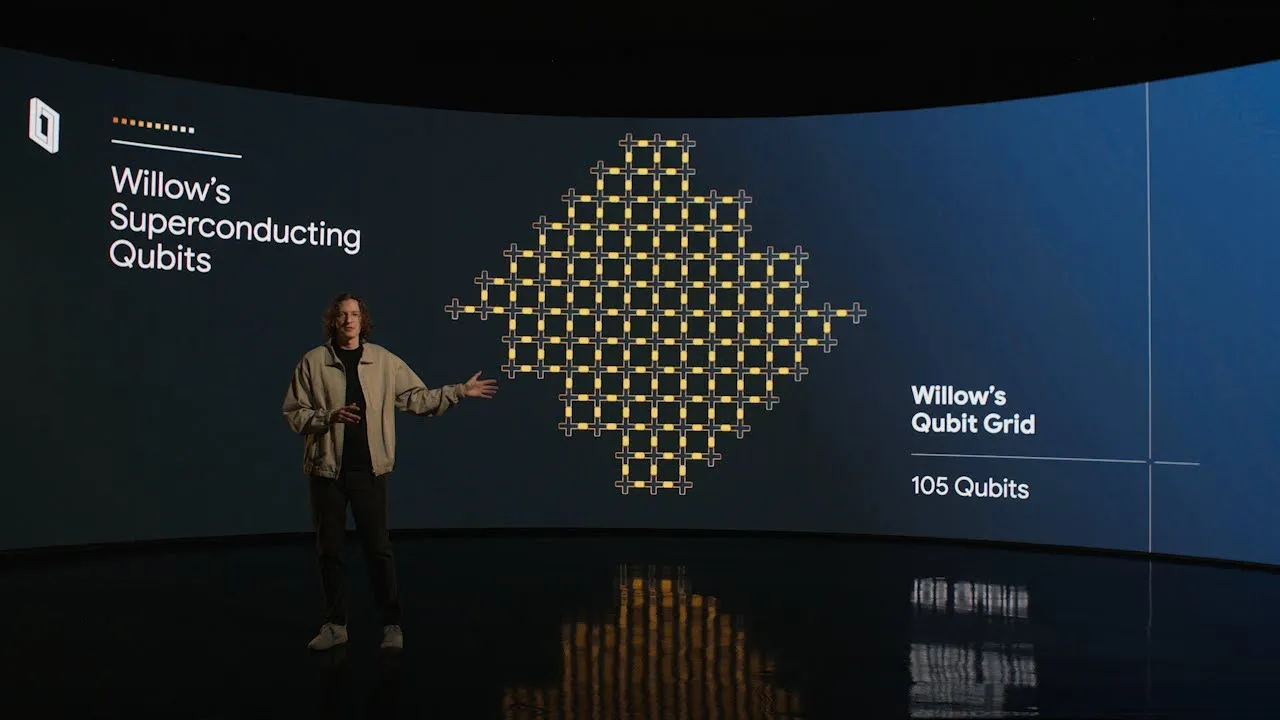 Play video: Google Quantum AI, introducing the Willow chip
What it means: Magic states are one of the most expensive items in the cost estimates of quantum algorithms. If a method that looks cheap on paper also works on real hardware, the machine needed in the future could shrink. But this is a first demonstration with small codes. Google itself says the next step is to show the method at large scale and that many technical hurdles remain. There is no figure for how much smaller the machine could get.
Claude redesigned quantum circuits
In a study Anthropic published on October 16, the Claude Mythos 5 model was given plain-language descriptions of what eight quantum circuit building blocks should do. The building blocks came from chemistry, optimization, simulation of quantum systems, number theory and numerical computing. An automated checker verified whether each proposed design worked correctly and scored it by the number of qubits and operations (gates) it used. Claude ran the propose, score and revise loop largely on its own: the researchers did not intervene between rounds and only occasionally asked it to broaden its search. The work was led by Andi Gu in Anthropic's STEM Fellows program, with contributions from Susanne Yelin and Mikhail Lukin of Harvard.
According to Anthropic, Claude's designs use fewer qubits and fewer gates than the best published circuits for all eight building blocks, in some cases by a factor of 10 or more. Two examples stand out:
- Elliptic curve point addition: A core component of the quantum algorithm that would break elliptic curve cryptography. For the modular inversion step, Claude developed what Anthropic calls the first reversible implementation, one that can run on a quantum computer, of a known method called divsteps. In a single 53-hour run, with humans providing only the initial brief and occasional nudges, it produced a family of designs that trade qubits against gates in different ways. One circuit in that family, for example, uses 12 percent more qubits but 17 times fewer gates than the smallest published design. The formula behind the design was checked with large-scale simulations and then formally verified in Lean, a proof assistant.
- Reed-Solomon decoder: Part of a quantum optimization algorithm (Decoded Quantum Interferometry). Reserving memory for the worst case would take 665 qubits; Claude instead simulated 403 million sample decodings and reserved room for just 19 qubits. The price is that roughly one run in 10,000 fails, which Anthropic considers well within the task's error tolerance. The gate count also fell 12-fold compared with Google's previous design.
Anthropic also spells out the limits of the work. The results are in a preprint that has not yet been peer-reviewed. The method suits algorithms whose correctness can be checked quickly on a classical computer, and qubit and gate counts are only a rough proxy for running time. Circuit design is just one layer of a usable quantum computer; error correction, decoding and hardware control matter at least as much. The company says that in early experiments Claude was overly cautious, re-checking solid results and falling back on familiar methods; to get past this, they asked it to develop several approaches at the same time.
What it means: AI has moved beyond writing code and is starting to produce results on research problems, especially those whose correctness can be checked automatically. This confirms a lesson familiar from software development: a good automated test environment is a precondition for running AI safely. There is also a security angle. The point addition circuit sits at the heart of a quantum attack on elliptic curve cryptography. So the cost of the attack on paper falls not only as hardware improves but also as algorithms get better, and AI can now make those improvements too.
Where else is AI helping quantum computing?
- Error decoding: Errors in a quantum computer cannot be seen directly; which error occurred is inferred from the pattern of check measurements. AlphaQubit, a neural network that Google DeepMind and Google Quantum AI published in Nature in November 2024, made fewer errors than the previous best methods on data from Google's Sycamore processor: 6 percent fewer than tensor network methods and 30 percent fewer than correlated matching. It was trained first on simulated data, then on samples from the real processor. But it is not yet fast enough to run in real time: superconducting processors produce millions of check measurements every second.
- Calibration: As in Google's experiment above, a processor's control settings can be tuned with reinforcement learning.
- Circuit and algorithm design: As the Claude example shows, language models can beat the best human solutions on design problems whose correctness can be checked.
In short, AI is now a tool in almost every layer of quantum computer development.
So will quantum computers speed up AI?
For now, the answer is no. There is no method that uses quantum computers to train or run large language models with a demonstrated advantage over classical hardware. The speedups claimed in quantum machine learning either stay confined to narrow problems chosen for quantum hardware or can disappear once better classical methods are found. In 2018 Ewin Tang, then an 18-year-old student, found a classical algorithm that eliminated the exponential speed advantage a quantum computer was thought to have on a recommendation system problem. Leading researchers in the field, such as Maria Schuld and Nathan Killoran, are also debating whether "quantum advantage" is even the right goal for quantum machine learning.
Google takes a longer view. In his December 2024 post introducing Willow, Hartmut Neven, who leads Google Quantum AI, wrote that quantum computers would be indispensable for gathering training data that classical machines cannot access, for training and optimizing some learning architectures, and for modeling systems in which quantum effects are important. This points to uses such as generating data for AI models from molecular and materials simulations. But it is an expectation, not a demonstrated result.
What it means: Be cautious with products and services sold under the "quantum AI" label. When you come across a concrete claim, ask two questions: Has the result been published in a peer-reviewed venue? Was it compared with the best classical method for the same problem?
The real business issue: encryption
The side of quantum computing that matters to companies today is encryption. Shor's algorithm, discovered in 1994, can break RSA and elliptic curve cryptography (ECC) on a sufficiently large quantum computer. Both are used in HTTPS connections, digital signatures, VPNs and cryptocurrencies. According to Google, symmetric encryption such as AES is not affected by this threat.
The threat starts before these machines exist: an attacker can record encrypted traffic today and decrypt it once quantum computers are ready. Because of this "store now, decrypt later" approach, data that must stay confidential ten years from now (health records, contracts, trade secrets, personal data kept for a long time) is considered at risk already.
How the estimates have shrunk
The estimated size of the quantum computer needed to break RSA-2048 has shrunk a thousandfold in 13 years. In March 2026, a similar estimate followed for the elliptic curve used by cryptocurrencies:
| Year | Target | Estimated machine | Study |
|---|---|---|---|
| 2012 | RSA-2048 | About 1 billion physical qubits | Earlier estimate compiled by Google |
| 2019 | RSA-2048 | 20 million physical qubits, about 8 hours | Gidney and Ekerå |
| 2025 | RSA-2048 | Fewer than 1 million physical qubits, under a week | Gidney (Google) |
| 2026 | The elliptic curve of Bitcoin and Ethereum (secp256k1) | Fewer than 500,000 physical qubits; 9 minutes or less, according to Google | Google Quantum AI and partners |
For comparison: according to Google's 2025 assessment, today's machines operating at the required error rates have between 100 and 1,000 qubits; Willow has 105. So nobody today has a machine that can break these schemes, but the gap narrows with every new study.
Google's March elliptic curve paper had another unusual side. Instead of publishing the attack circuits, the team shared a "zero-knowledge proof" showing, without revealing the circuits, that they exist and work correctly within the stated bounds. In April, the security firm Trail of Bits exploited bugs in the software that generated this proof to produce a fake proof that looked better than Google's on every measure. Google fixed the bugs; according to Trail of Bits, the paper's scientific claims are unaffected. As the firm put it, the episode turned a quantum computing problem into an ordinary application security problem.
What does the timeline say?
| Date | What happens |
|---|---|
| August 2024 | NIST published the first three post-quantum cryptography standards: ML-KEM for key exchange, ML-DSA and SLH-DSA for signatures. |
| December 31, 2026 | First milestone of the coordinated roadmap that EU member states published in June 2025: national transition preparations, cryptographic inventories and mapping of dependencies, including supply chains. |
| 2029 | Google's target for completing its own transition (announced in March 2026). |
| December 31, 2030 | Under the EU roadmap, high-risk use cases should have moved to post-quantum cryptography. Under NIST's draft timeline, schemes at the 112-bit security level, such as RSA-2048, become "deprecated" after 2030. |
| 2035 | Under the NIST draft, approval for these quantum-vulnerable schemes is withdrawn entirely. The EU also aims for medium-risk use cases to make the switch and for as many systems as possible to move to post-quantum or hybrid cryptography. |
The transition has already begun: Google has moved key exchange in Chrome and in its own internal traffic to ML-KEM, and is adding ML-DSA signatures to Android 17. At the time of writing, we found no binding transition timeline published for Turkey. Companies working with customers and partners in the EU would do well to follow the EU timeline.
What it means: Nobody knows when a quantum computer will be able to break encryption; Google's March post gives no date either. But the standards are ready, and the transition takes years. Google moving its own target ahead of the official timelines, to 2029, shows that the cost of waiting is rising.
The situation in Turkey
In Turkey, the most concrete step is on the hardware side. In June 2026 the Presidency of Defence Industries (SSB) and ASELSAN signed a project to develop a superconducting quantum processing unit (QPU) in Turkey. ASELSAN is the prime contractor, with Sabancı University, Koç University and TÜBİTAK's National Metrology Institute (UME) taking part. The processors are to be made at the country's first superconducting fabrication facility, which is still being built, and serial production is planned at facilities to be set up within ASELSAN. The number of qubits and the timeline have not been announced. According to ASELSAN's CEO Ahmet Akyol, the company has been working on quantum technologies since 2021.
What should companies do today?
You don't need to buy a quantum computer or set up a quantum program. But on the encryption side there is work that can start today and will take years:
- Build a cryptographic inventory. Which system, which connection and which document uses which encryption and signature scheme? Websites, VPNs, email, ERP and banking integrations, backups, certificates and field devices all belong on this list. The EU roadmap also starts with the inventory.
- Prioritize data that must stay secret for a long time. Data that must remain confidential ten years from now is the most exposed to "store now, decrypt later" attacks.
- Ask your suppliers. What is the post-quantum roadmap of your software, cloud and hardware providers? In which version will ML-KEM and ML-DSA support arrive?
- Make encryption replaceable. Bring systems where the algorithm is hard-coded to a state where they can switch to a new scheme through configuration. When developing new software, design this flexibility in from the start.
- Don't forget signatures. Google prioritized authentication and signature services in its transition, because signatures need to be replaced before a quantum computer capable of breaking encryption appears.
- No need to panic. According to Google, symmetric encryption such as AES is not affected by this threat, and Chrome and Google's own services have already started the transition. The real task is to plan the same transition for your own systems.
These steps are a general starting list; the details vary from system to system. A cryptographic inventory and infrastructure security are a natural part of cybersecurity work.
What remains unclear
- Will Google's result scale? The experiment covers small codes; the state waiting in the larger code showed more error than expected. How much smaller the required machine will get is not known.
- Claude's circuits: The results are in a preprint; there is no independent review by other researchers yet.
- When will a machine break encryption? Unknown. Estimates are shrinking, but today's machines are far below the required size. Google set 2029 as a transition target; it gave no date for when such a machine will appear.
- Turkey's timeline: It is unclear when, and with what scope, a national timeline for the transition to post-quantum cryptography will come.
Quantum computers are not speeding up AI today; AI, however, is speeding up quantum computers. Where the two meet, the most concrete takeaway for companies is encryption: the best time to migrate is before the machines are ready.
If you are thinking of adding AI to your product or processes, take a look at our AI solutions or get in touch.
Sources
- Google: Magic state cultivation (October 15, 2026)
- Science: Magic state cultivation on a superconducting quantum processor and the arXiv preprint
- The Quantum Insider: Google Demonstrates Method to Cut Errors in Quantum Computing's 'Magic States'
- Google Quantum AI: Meet Willow, our state-of-the-art quantum chip (YouTube)
- Google: Meet Willow, our state-of-the-art quantum chip (Hartmut Neven, December 2024)
- Anthropic: Designing more efficient quantum circuits with Claude (October 16, 2026) and the arXiv preprint
- Google: AlphaQubit and the Nature paper
- Quanta Magazine: Ewin Tang's classical recommendation algorithm (2018)
- Schuld and Killoran: Is quantum advantage the right goal for quantum machine learning?
- Google: Tracking the cost of quantum factoring (May 2025) and Gidney's paper
- Google Quantum AI and partners: Securing Elliptic Curve Cryptocurrencies against Quantum Vulnerabilities (March 2026)
- Trail of Bits: We beat Google's zero-knowledge proof of quantum cryptanalysis (April 2026)
- Google: Quantum frontiers may be closer than they appear (March 2026)
- NIST: The first three post-quantum cryptography standards (August 2024) and the NIST IR 8547 draft
- EU: Coordinated implementation roadmap for the transition to post-quantum cryptography (June 2025)
- Forbes Türkiye: ASELSAN's superconducting quantum processor (June 2026, in Turkish)