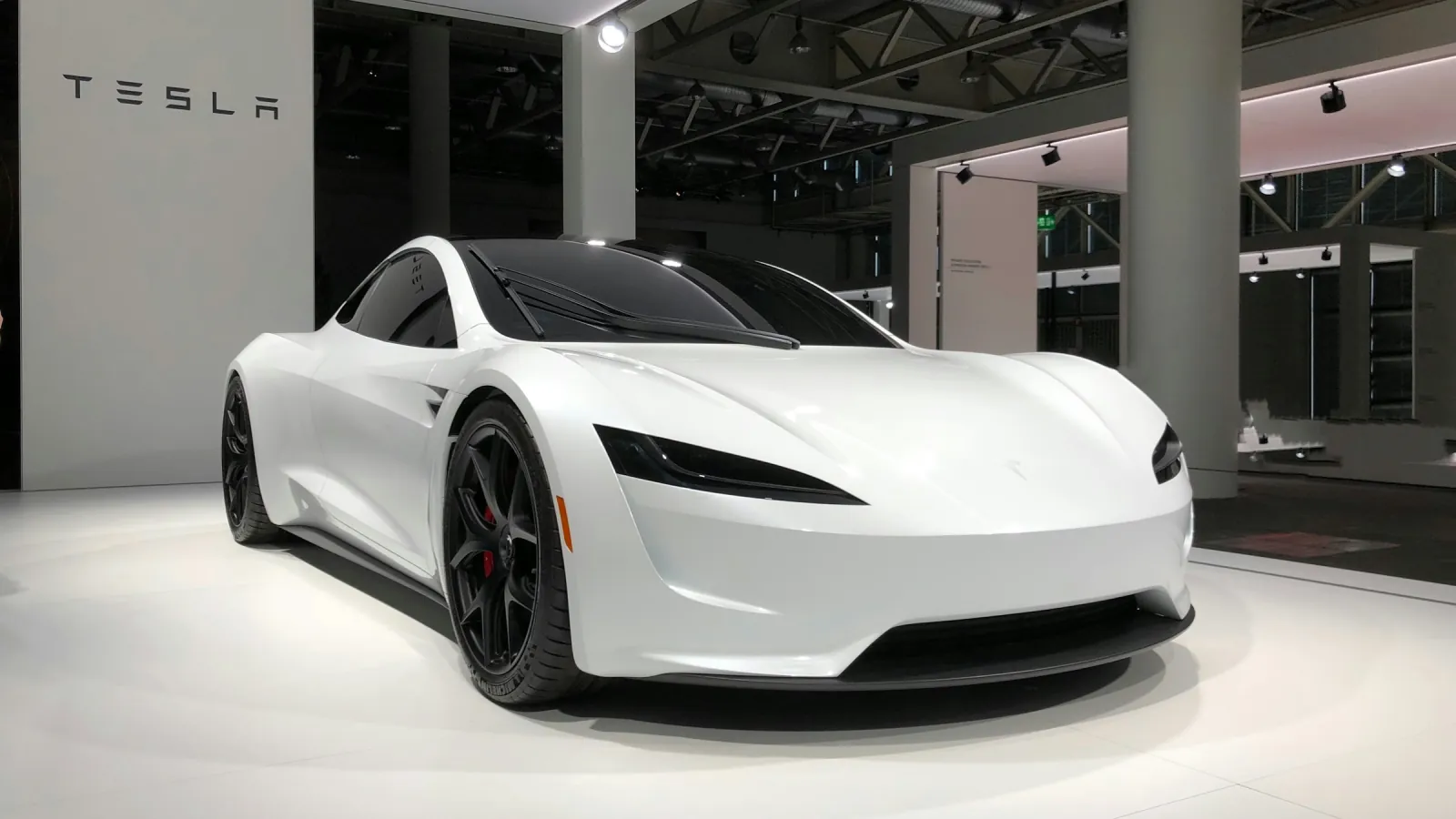
On October 15, 2026, Tesla unveiled its long-delayed new Roadster at SpaceX's rocket test site in McGregor, near Waco, Texas, almost nine years after the first prototype was shown. The car drove upside down along a curved ramp, flipped through the air on thrusters and landed, and jumped over other Tesla models. Production is due to start in 2028; no sale price was announced.
Most viewers watched the thrusters. What interests us more is the part you cannot see: the software that controls the steering, brakes, fans and thrusters in fractions of a second, and the Roadster's place in Tesla's AI strategy. For this article, we brought together Tesla's announcements, interviews with its engineers, a 2025 Tesla patent and the company's official reports.
Information as of October 18, 2026. Performance figures are Tesla's claims and have not been independently measured. Quotes from video interviews are taken from automatic captions. All sources are listed at the end of the article.
What was shown at the unveiling?
The Roadster first climbed a curved ramp and, thanks to the fan-driven suction system in its underbody, held on to the surface upside down. Then the cold-gas thrusters developed with SpaceX kicked in: the car left the ramp, rotated in the air and landed on its wheels. In another demonstration, the thrusters carried the car over a Cybercab, a Cybertruck, a Semi, a Model Y and a Model 3. Nobody was driving the car during the ramp and jump demonstrations.
In a live run, Tesla also showed the car going from 0 to 60 mph (about 97 km/h) in 0.81 seconds. That time is Tesla's own measurement; there is no independent one. Tesla says the top Rocket version can fly; what the show demonstrated was a short, controlled lift-off. The press is cautious too: CNN ran its story under the headline "Tesla unveils what it says is a flying car, called the Roadster."
 Play video: Tesla, Roadster unveiling livestream
Three versions, 2028 and no price yet
On the reservation page it reopened on the day of the unveiling, Tesla lists the car in three versions:
| Version | Positioning | Seats | Thrusters | Reservation |
|---|---|---|---|---|
| Performance | For the road | 2 | None | $50,000 |
| Thrust | For the track | 2 | 4 at the rear | $250,000 |
| Rocket | For the air | 1 | 10 around the body | By invitation only |
According to Tesla, the range is over 300 miles (about 480 km) and the top speed over 230 mph (about 370 km/h). The Rocket is not approved for road use, as Tesla's page itself notes. No sale price was announced; at the first unveiling in 2017, the base price was given as $200,000. Morningstar analyst Seth Goldstein expects about 2,000 Roadsters to be sold a year; Tesla sold 1.6 million vehicles last year. The Roadster's real role is to be the brand's showpiece.
It pays to be cautious about the timeline. The Roadster's history is one of slipping dates:
November 2017 Delayed
The first prototype was shown; deliveries were targeted for 2020.
2020–2024 Delayed
The target date was pushed back again in 2020, 2021, 2023 and 2024.
November 2025 Delayed
Musk pointed to April 1, 2026 for the unveiling and 2027 for production.
October 1, 2026 Delayed
The planned unveiling slipped by two weeks because of heavy rain.
October 15, 2026 Held
The unveiling took place at the SpaceX test site in McGregor.
2028 Target
Production is planned to start.
You are driving a computer: by-wire and a single controller
In the Roadster, software sits between the steering, brake and accelerator and the wheels instead of a mechanical link. According to Tesla's page, the yoke-style steering is designed for direct by-wire control, and the livestream said the brake and accelerator are by-wire too. Tech commentator Robert Scoble summed it up on X: you are not really driving the Roadster. "You are driving a computer and it is telling another computer how to drive the car." Musk replied: "True."
Lars Moravy, Tesla's vice president of vehicle engineering, explained how this computer works in an interview with MotorTrend. According to Moravy, Tesla's strength is integrating vehicle dynamics systems; since the Model S, the company has developed these systems together and kept building on them. In the Roadster, by-wire steering, by-wire braking, traction control, the adaptive drivetrain, suspension damping and active aerodynamics are managed by "one primary vehicle dynamics controller," which uses each of them as one of the system's actuators. Based on a physics model, the controller works out the right response to the driver's input; Moravy describes it as a "self-optimizing" system.
The hardware was chosen with this software in mind as well. According to Tesla's X account, the rear wing is moved by the actuator system developed for Optimus, the company's humanoid robot. In Track Mode, the car lowers itself, the suspension changes and the driver can switch between high-downforce and low-drag modes.
What it means: In a by-wire car, the driver's movement does not go straight to the wheels; it goes to the software as a request. The software interprets that request according to speed, grip and the car's current state: it can adjust the steering response, distribute braking between the wheels and deploy the wing. The same architecture also makes the driverless maneuvers in the show possible: when the command comes from a program instead of a person, the rest of the car works the same way.
The software behind upside-down grip: fans, skirts and a state machine
According to Tesla, the multi-mode fan and ground-sealing system works like a downforce generator, pulling air out from under the car, and provides enough suction to hold the car upside down even when it is stationary. Moravy explains that the system has two sources: above 50 mph, the front wings and the hood duct can produce as much downforce as the suction system. As speed rises, the wings come into play, while the fans increase the underbody flow and press the car down even further. In Moravy's words, the team has to be careful about which one it uses and when. That decision is made by software.
Fan-based grip is not a new idea. In April 2025, the British company McMurtry drove its electric single-seater, the Spéirling, upside down for five seconds using fan suction. What sets the Roadster apart is that the system is built into a road car and tied to a single controller.
Tesla has not explained how the fan system makes its decisions. A patent the company filed in April 2025 and was granted in August 2025, "Adaptive vehicle aerodynamics for downforce" (US 12,377,920 B1), still offers a clue. The patent does not name the Roadster, but the fan-and-skirt system it describes matches what was shown:
Sensors
Speed, wheel position, pitch and roll, ride height (laser, camera, millimeter-wave radar, ultrasonic), GPS and surface conditions.
Prediction
GPS and map data are used to anticipate changes in road conditions.
State machine
A state machine with hysteresis manages transitions between modes, so the system does not flip back and forth at a threshold.
Mode 1: high downforce
Low speed and flat surfaces (0–60 launch, autocross): all skirts lower, the underbody becomes a sealed chamber and the center fans run.
Mode 2: changing conditions
High speed or rough surfaces: only the side skirts stay down, and all center and outer fans run.
According to the patent, the driver can also select the mode manually at the start of a session. In one example in the patent, the system runs on an automotive-grade microcontroller at 400–800 MHz.
What it means: The decision mechanism described in the patent is not a learning model but a state machine running on explicit rules. Engineers still prefer this approach for fast, predictable and safety-critical decisions. Hysteresis is a good example: if the system switched to one mode as soon as the speed went just above a threshold and back to the other as soon as it dipped just below, it would keep toggling. That is why a buffer zone sits between the two modes.
A flip in the air: attitude control borrowed from rockets
According to Tesla's page, the cold-gas thrusters deliver precise thrust with fully electric actuators and keep the car balanced in the air by making micro-adjustments in fractions of a second. TechCrunch reports Moravy as saying that the Rocket's 10 thrusters lift and rotate the car using 600 liters of pressurized gas. Alongside the main thrusters at the rear, attitude control thrusters manage the car's orientation; two of them keep it balanced by controlling its rotation about its own axis. Tesla's post on X sums up the hard part: SpaceX has used thrusters to position spacecraft for decades, and making them work "on a vehicle instead of a vacuum took all-new hardware & controls."
Tesla's answer to the question of who controlled the maneuvers is brief: according to Musk, the car was technically autonomous during the show, to make sure nobody would be killed. Which software was running has not been disclosed. Before the event, Electrek, citing The Information, had reported that the car would be remotely controlled with nobody inside; Engadget wrote that the maneuvers were preprogrammed into the car. In his reply to Scoble on X, posted on October 17, Musk also wrote: "You will be able to ask the Roadster to perform any of the tricks shown autonomously, as it will be sentient." There has been no explanation of how or when this would happen.
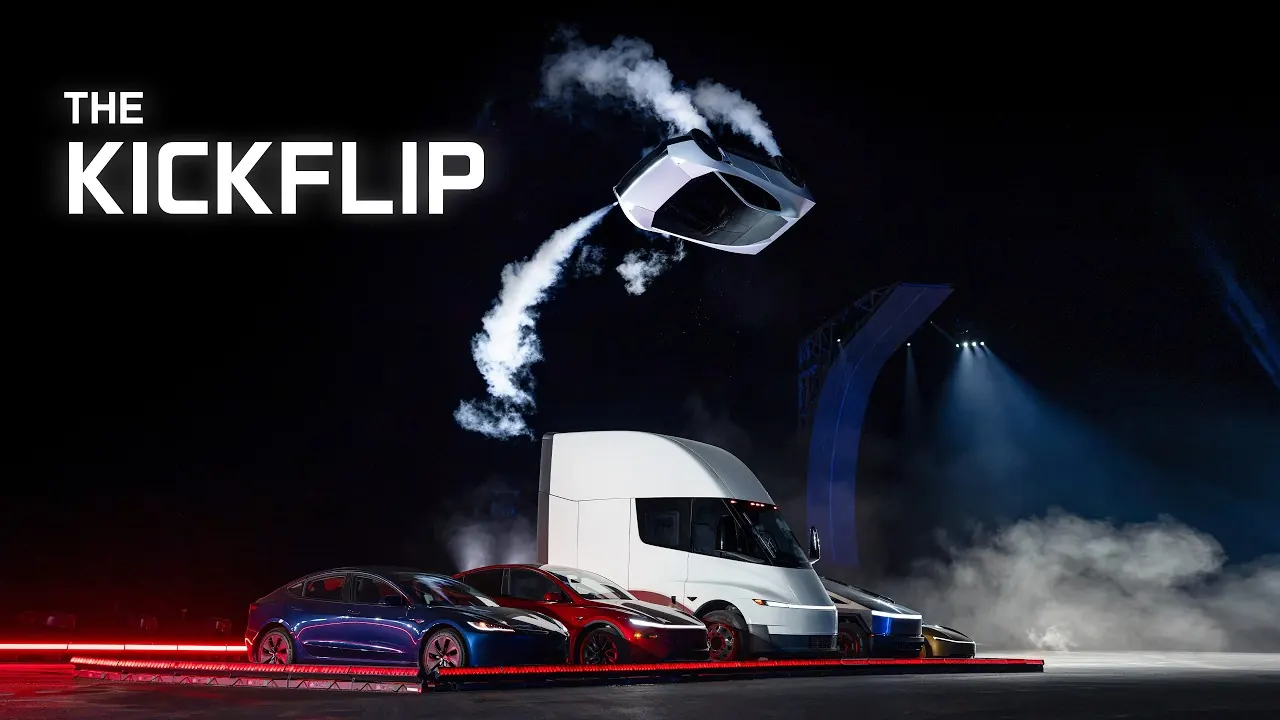 Play video: Tesla, Roadster: The Kickflip
What it means: Keeping a car balanced in the air takes a control loop that measures its orientation many times per second and fires the thrusters in short pulses. The systems that keep spacecraft pointed in the right direction work on the same principle. A loop this fast cannot be run on human reflexes, which is one reason the show was driverless. Musk's "sentient" car, on the other hand, is not an engineering term; for now, it is best read as a marketing line.
The last car humans drive, in the age of AI
Musk described the Roadster as the best of the last cars that humans will drive and said that, in the long run, it would be Tesla's only manually driven car. The remark makes more sense next to the direction the rest of the company is taking. According to Tesla's second-quarter report, published in July 2026:
- The robotaxi service operates in seven major metropolitan areas in the US. In Austin, Dallas, Houston, Miami, Orlando and Tampa, rides without a safety monitor are being expanded; in the San Francisco Bay Area, there is a safety driver in the car.
- Cybercab, the two-seat robotaxi without a steering wheel or pedals, has entered production at the Texas factory. It has been giving public rides in Austin since September 2026, while the US traffic safety agency NHTSA reviews its certification against federal safety standards.
- The Model S and Model X production lines at the Fremont factory have been decommissioned, and the first production lines for the Optimus humanoid robot are being installed.
- The company's quarterly capital expenditure rose from $2.4 billion to $5.8 billion in a year. The report says Tesla is in its largest and most exciting investment period, and it links the rise in operating expenses to AI and R&D projects.
Why will the Roadster get only a limited FSD?
On a walkaround with MotorTrend, Tesla's chief designer Franz von Holzhausen said the Roadster will run a limited version of FSD (Full Self-Driving), Tesla's driver-assistance software. He pointed to the steeply raked windshield and to the car being conceived as a performance car, and noted that the camera and hardware are in the car. Which features will be restricted has not been announced.
To understand this decision, it helps to look at how FSD is developed:
- A single neural network: With version 12 in 2024, Tesla moved the software that handles city driving to a single end-to-end neural network. According to the release notes, this network, trained on millions of video clips, replaced more than 300,000 lines of hand-written C++ code. In version 14.3.12, released on October 10, 2026, Actually Smart Summon, FSD and the robotaxi use the same model.
- Fleet data: According to Tesla Europe, the system is trained on billions of kilometers of real-world driving data. Total distance driven on FSD passed 10 billion miles (about 16 billion km) in May 2026. When a driver takes over, the screen asks why; this information is also collected to improve the software.
- Compute: Training takes place in the Cortex 1 (over 90 megawatts) and Cortex 2 (over 115 megawatts) data centers in Texas; Tesla more than doubled this capacity in the first half of 2026. Volume production of AI5, the next-generation computer for its cars, has slipped to 2027.
Fleet
Teslas on the road collect camera footage and driver interventions.
Training
This data is used to train a single end-to-end neural network in the Cortex data centers.
Update
The new model is sent to cars as an over-the-air (OTA) update.
Driving
The network turns camera images into steering, acceleration and braking decisions; driver supervision is mandatory.
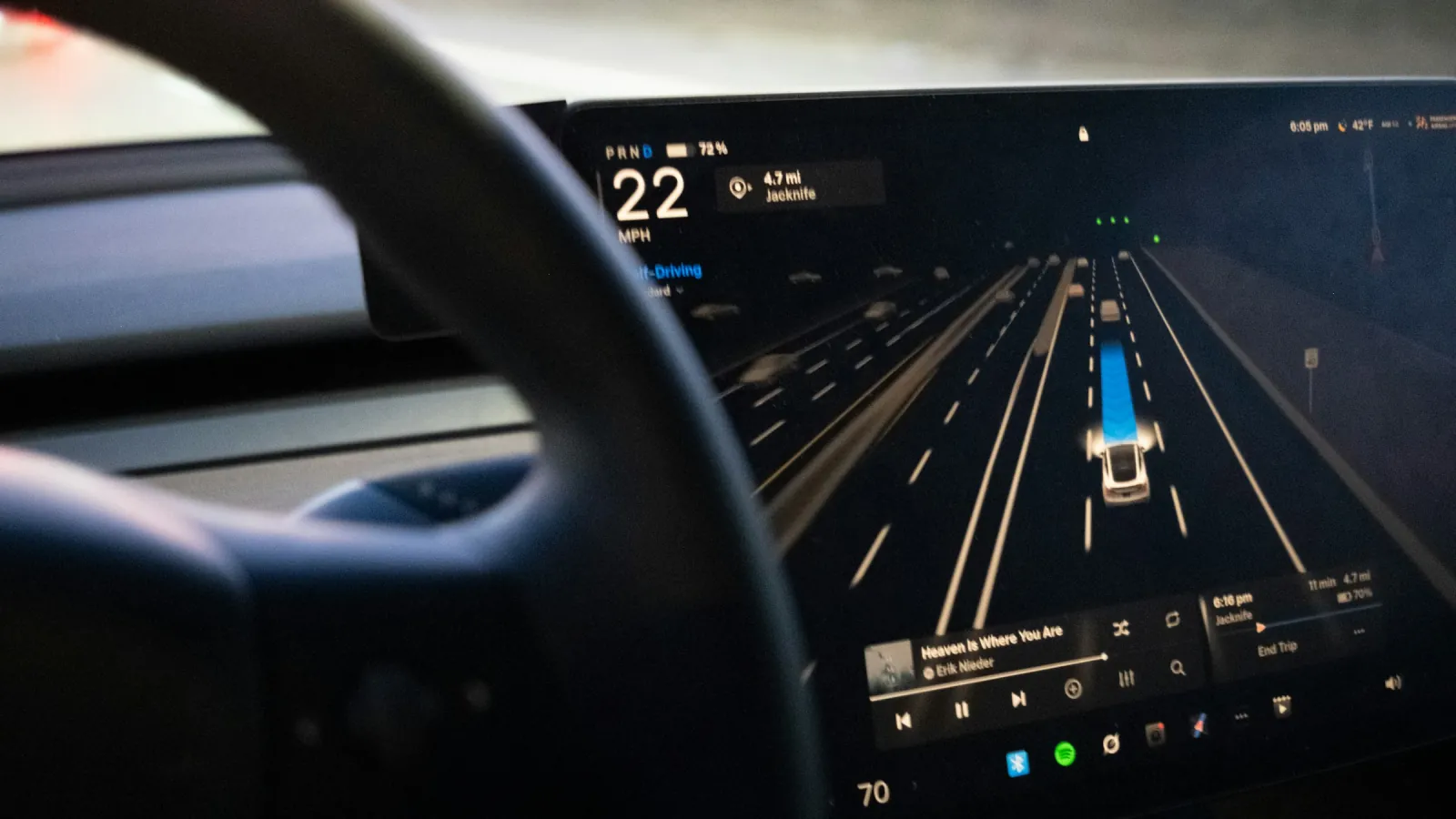
What it means: FSD's strength comes more from data than from code. The network is trained on the world seen by the cameras of millions of cars; these cars carry their cameras at certain heights and angles and move in certain ways. A car whose cameras sit elsewhere, that moves much faster and very differently, and of which only a few thousand will be built each year, is almost absent from that data. The author at Not a Tesla App also believes the design creates situations FSD was not trained for, and that separate training for a car that will sell in such small numbers is impractical. AI is strong where data is plentiful.
The situation in Turkey and Europe
FSD still runs in "Supervised" form in customer cars: in the words of Tesla's reports, it requires the driver's constant supervision and does not make the car autonomous. In Europe, the process that began with the Netherlands' approval in April 2026 had reached eight approving countries by the end of September. In October, the system was renamed "Tesla Assisted Driving" in Europe; an EU-wide vote on recognizing it has been pushed to December at the earliest. In Turkey, FSD is not yet active: in May 2026, Tesla announced a monthly subscription price of 4,990 Turkish lira and filed an official application; approval is pending.
AI in the cabin: Grok
In Tesla cars, AI is not only in the driving but in the cabin as well. Since July 2025, the company has been adding Grok, xAI's chat assistant, to its cars. With the 2026 summer update, Grok can make phone calls, find and play music, and adjust the climate control. Whether the Roadster will have Grok has not been announced.
Four lessons for businesses
The Roadster is a supercar, but the thinking behind it will feel familiar to companies of any size:
- Software now defines the product. In the Roadster, every part from the steering to the rear wing is an actuator of a single controller. A new feature often means new code, not a new part. For your machine, device or service too, the difference is increasingly made in the software layer.
- Not every decision should be left to AI. Tesla leaves driving to a neural network that learns; according to its patent, it entrusts the fan system's mode to a state machine running on explicit rules. Rules for decisions that must be fast, predictable and auditable, learning models for complex perception: a good architecture uses both.
- AI is strong where the data is. Even Tesla's most ambitious AI product remains limited in a car built in small numbers. In in-house AI projects too, the first question should not be "which model?" but "do we have enough of the right data?" We explain which data and rules an in-house assistant should work with in our article on the in-house AI assistant and KVKK.
- A show is not a product. An impressive live demonstration does not mean measured performance, regulatory approval or a delivery date. In AI projects, the same gap exists between an eye-catching demo and a system that works reliably every day. Run a small trial with your own data before you decide.
What remains unclear
- Price: Only the reservation amounts have been announced.
- The show's software: The maneuvers were said to be technically autonomous; which software ran and whether there was a remote link has not been disclosed.
- FSD's scope: It is not clear what the limited version will include.
- Thrusters: The type of gas (Tesla speaks of air in the livestream, while Hagerty's interview with Moravy mentions nitrogen) and how long the tanks take to refill remain unclear. Refilling currently takes hours; Tesla's goal is to bring it down to half an hour.
- Legal status: Tesla writes that the Rocket is not approved for road use. According to Reuters, it is also not yet clear whether features of the other versions can be used legally on the road.
- Safety: Musk said safety is not the main goal; on a podcast earlier this year, he had also said that if safety is your number one priority, you should not buy a Roadster. TechCrunch points out that the carbon-fiber-wrapped pressure vessels (COPVs) in the car are the type of tank behind more than one SpaceX rocket explosion.
The Roadster is not a car that will change Tesla's sales figures, and Musk acknowledges as much. But the show could hardly have made the point more vividly: the car is now a software product.
If you are thinking about adding AI to your product or processes, take a look at our AI solutions or get in touch.
Sources
- Tesla: Roadster page
- Tesla: Roadster unveiling livestream (YouTube) and The Kickflip clip
- Tesla on X: thrusters and "all-new hardware & controls" and the wing driven by Optimus actuators
- MotorTrend: Lars Moravy on the Roadster's technology (YouTube) and walkaround with Franz von Holzhausen (YouTube)
- Robert Scoble's post and Musk's reply
- Google Patents: US 12,377,920 B1, Adaptive vehicle aerodynamics for downforce
- Tesla: Q2 2026 update (SEC)
- Reuters (The Spokesman-Review): Tesla unveils next generation Roadster sports EV with SpaceX thrusters
- TechCrunch: Tesla reveals SpaceX-powered Roadster that flies and falls with style
- The Drive: Tesla Roadster coming in 2028
- InsideEVs (Yahoo Autos): The Tesla Roadster's thrusters last seconds, refilling takes hours
- Not a Tesla App: Why the new Tesla Roadster won't get full FSD
- Electrek: Tesla's flying Roadster demo, no driver (August 2026)
- Engadget: Tesla's redesigned Roadster
- CNN: Tesla unveils what it says is a flying car, called the Roadster
- Wikipedia: McMurtry Spéirling
- Not a Tesla App: FSD v12 release notes and 2026.38.5 (FSD 14.3.12) release notes
- Electrek: FSD passes 10 billion miles and approval in the Netherlands
- Electrek: the AI5 chip and its timeline
- Not a Tesla App: approval in Croatia and the EU vote and the new name in Europe
- DonanımHaber: Tesla Turkey FSD subscription price and official application (in Turkish)
- TechCrunch: NHTSA's Cybercab investigation and Electrek: Cybercab opens to the public
- Not a Tesla App: Tesla software update 2025.26 (Grok)